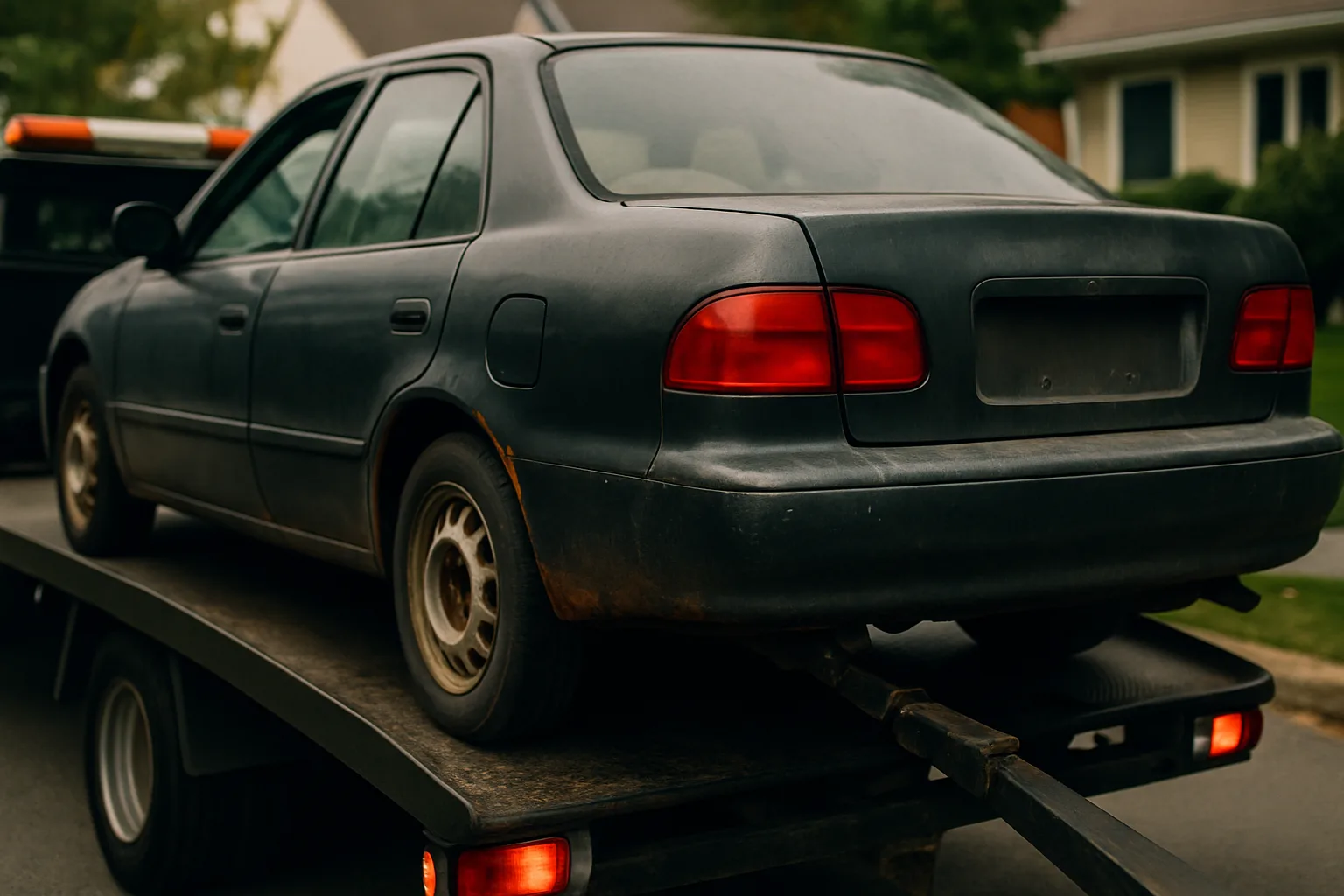
Your Neighbor Got $800 for His Old Civic. You Got $300 for a Similar Year. Here's Why.
Same decade. Same general condition. Two completely different payouts. If you've ever compared notes with someone else who sold a scrap car and walked away confused about the price gap, you're not alone. Scrap car value today isn't a flat number — it's a moving target shaped by what you're driving, what condition it's in, and what the market wants right now. Understanding that gap can put real money back in your pocket.
This isn't about getting lucky. It's about knowing what drives the number before you accept a quote. Whether you're parked in Trois-Rivières with a rusted-out pickup or sitting on a non-running SUV in suburban Quebec, the variables behind your payout are the same — and they're worth knowing.
The Weight Factor: Why a Heavier Vehicle Usually Pays More
At the most basic level, scrap cars are sold by weight. Steel and iron make up the bulk of any vehicle, and auto recyclers pay based on how many pounds of recoverable metal you're handing over. A full-size truck or an older body-on-frame SUV can tip the scales significantly heavier than a compact sedan — and that difference shows up directly in your payout.
A mid-size car might weigh around 1,400 to 1,600 kilograms. A full-size pickup or large domestic van can push 2,200 kilograms or more. When ferrous metal prices are at a reasonable level, that weight difference alone can translate to hundreds of dollars. This is why a beat-up F-150 often fetches more at scrap than a well-maintained economy hatchback. Steel doesn't care about cosmetics — it cares about tonnage.
- Economy cars (Civic, Corolla, Versa): Lower curb weight, lower base scrap value
- Mid-size sedans (Camry, Accord, Malibu): Middle of the range — moderate payout
- Full-size trucks and SUVs (F-150, Silverado, Tahoe): Heavier steel content, typically stronger scrap floor
- Minivans and cargo vans (Caravan, Transit, Econoline): Often underestimated — solid weight, good scrap returns
If you're in Trois-Rivières and you're not sure what your specific vehicle weighs, a reputable scrap buyer will factor this in when they assess your quote. Don't assume your car is worth less just because it's older — sometimes the heavy domestic iron from the early 2000s outperforms a newer lightweight import at the scale.
Make and Model: Why Some Cars Are Worth More Than Their Weight
Weight explains the floor. Make and model explain everything above it. Certain vehicles hold higher scrap value because of their parts — not their steel. A catalytic converter on a late-model hybrid can be worth more than the entire steel content of a small sedan. High-demand engines, transmissions, and electronics all factor into what a buyer is willing to pay before the car ever hits the crusher.
Toyota, Honda, and certain GM and Ford models have strong parts demand in the used and remanufactured markets. When recyclers can pull a functioning alternator, starter, or door assembly and resell it, they can afford to pay you more upfront. That's not charity — it's them pricing in the part value before they scrap the shell. Meanwhile, an obscure import with limited parts demand offers the recycler nothing beyond steel, which brings the offer down accordingly.
Catalytic converters deserve special mention here. Vehicles with larger or multi-cat exhaust systems — certain trucks, luxury cars, and hybrids — carry meaningful precious metal content (platinum, palladium, rhodium) inside those converters. That content is recoverable and valuable. Platforms like SMASH, which operates as a B2B scrap metal marketplace, allow auto recyclers and processors to auction catalytic converters and other non-ferrous materials competitively — which is a big part of why transparent pricing matters at every stage of the chain. When buyers compete, the data improves for everyone.
Condition Isn't Just About Rust — It's About What's Still There
Here's where a lot of sellers lose money without realizing it: condition isn't just about whether the car runs. It's about whether the valuable components are still attached and intact. A non-running car with a full exhaust system, intact catalytic converter, a decent battery, and four inflated tires is worth more than a "running" car that's been stripped of its cats, missing its airbags, and sitting on three flats.
Auto recyclers assess condition on multiple levels:
- Running vs. non-running: A car that starts and moves under its own power is easier to process and often yields better parts. But non-running vehicles are bought daily — don't assume you're out of the game.
- Completeness: Are the catalytic converters still on? Is the battery present? Are the airbags deployed or intact? Each missing component reduces the offer.
- Body condition: Heavy rust that has compromised structural integrity affects the weight (rust is lighter than solid steel) and the usability of any body panels.
- Fluid situation: A vehicle leaking fuel, coolant, or oil at scale can create disposal complications that recyclers factor into their price.
- Title and documentation: A clean title in your name simplifies the transaction. Missing paperwork creates friction — and friction costs you money.
If you're in Quebec and your car has been sitting outside through a few hard winters, be honest about what's still on it. Recyclers in Trois-Rivières see plenty of salt-eaten vehicles — they know what to look for. Trying to hide a stripped converter or a missing engine component will come out at pickup, and it complicates what could have been a clean transaction.
Why Scrap Car Value Today Moves With the Metal Market
Even if your car hasn't changed at all, its scrap value can shift month to month. Steel prices fluctuate based on global demand, energy costs, and what mills are willing to pay for feedstock. When North American steel prices climb, recyclers can afford to pay more per tonne — and that trickles down to your payout. When prices soften, the offers come in lower.
The same applies to non-ferrous metals. Copper wiring, aluminum wheels, and the precious metals inside catalytic converters all move with their own market cycles. A spike in palladium prices — which has happened multiple times in recent years — directly increases the value of certain vehicles' exhaust systems. You won't always know when these windows open, which is why timing your sale (if you have that flexibility) can matter.
This is where a platform like SMASH changes the game for the B2B side of the equation. The SMASH scrap metal auction model puts buyers in competition with each other, which means recyclers processing your vehicle are working within a market that's actively price-discovering. Better price discovery upstream means more accurate, competitive offers downstream — including what your car is worth at the gate. To understand how that works at scale, read Canadian scrap car guides that break down how recyclers think about pricing.
Disclaimer: Scrap metal prices fluctuate based on market conditions. Always check current rates before accepting a quote.
The Trois-Rivières Angle: Local Market Conditions Matter Too
National metal prices set the baseline. But local conditions in Trois-Rivières and across Quebec shape the final number. Proximity to processing facilities, local buyer competition, and even seasonal factors (how many people are offloading winter-damaged cars in spring) all influence what you'll actually get offered.
A car sitting in a rural area far from a processing yard costs the buyer more to collect — and that towing cost gets baked into your offer. Sellers in Trois-Rivières, which sits along the Saint Lawrence with solid transport corridors, are often in a better position than someone in a remote community with one local buyer and no competition. More buyers in your area means better price discovery. Less competition means take-it-or-leave-it offers.
If you're ready to move your vehicle, schedule a free scrap car pickup and see what the current market looks like for your specific make and model in your area. Free towing removes one of the biggest friction points — you shouldn't be paying to have someone take something off your hands.
For another perspective on how this works across provinces, Canadian scrap car removal from GetMyScrapCar is another resource worth checking if you want to compare options before committing.
How to Get the Most Accurate Quote for Your Scrap Car
Vague information gets vague quotes. If you want an accurate offer, come prepared with the details that actually move the number. This isn't complicated — it just requires you to know what matters before you pick up the phone or fill out a form.
- Year, make, model, and trim: The specific trim can affect parts value. A base model and a fully loaded version of the same car aren't worth the same at scrap.
- Current condition: Does it run? What's missing? Any major damage beyond normal wear?
- Catalytic converter status: Is it still on the vehicle? This is one of the first questions any serious buyer will ask.
- Location: Your postal code affects towing logistics and which buyers can realistically serve you.
- Title availability: Do you have the ownership document? Having it ready speeds everything up.
When you sell your scrap car in Canada, you deserve a quote based on real information — not a lowball designed to leave room for the buyer's margin. Knowing what drives value puts you in a stronger position from the first call.
The scrap car market in Canada isn't going anywhere. End-of-life vehicles need to be processed, metals need to be recovered, and recyclers need inventory. Your car has value — the question is whether you're capturing it or leaving it on the table. Get a free quote at sell-myscrapcar.ca and find out what your specific vehicle is worth in today's market.
Frequently Asked Questions
Q: What is my scrap car worth today in Trois-Rivières?
Scrap car value today in Trois-Rivières depends on your vehicle's weight, make, model, condition, and current metal market prices. There's no universal flat rate — a full-size truck will typically fetch more than a compact car. Get a quote specific to your vehicle for an accurate number, and remember that prices fluctuate with the metal market.
Q: Does a non-running car still have scrap value in Quebec?
Yes. Non-running vehicles are bought regularly across Quebec, including in Trois-Rivières. The car's weight, parts inventory, and catalytic converter status all contribute to its value regardless of whether it starts. Be upfront about condition so your quote reflects reality from the start.
Q: Why do some makes and models get higher scrap car prices than others?
Higher-demand vehicles have parts that recyclers can resell before crushing the shell — engines, transmissions, catalytic converters, and electronics. Vehicles with limited parts demand are priced mostly on steel weight alone. Trucks, certain domestic models, and hybrids with valuable catalytic converters often outperform compact imports in total scrap value.
Q: Is free towing actually included when I sell my scrap car in Canada?
Yes — reputable scrap car buyers across Canada, including in the Quebec market, offer free towing as part of the service. You should never be charged for pickup when selling a scrap vehicle. If a buyer is deducting towing from your offer without disclosing it upfront, ask for clarification before agreeing.
Q: How does SMASH fit into the scrap car market?
SMASH operates as a B2B scrap metal marketplace where auto recyclers and metal buyers compete in auctions for loads and materials — including catalytic converters and non-ferrous metals pulled from end-of-life vehicles. That upstream competition improves price discovery across the supply chain. Better market transparency at the recycler level can lead to more accurate and competitive offers for vehicle sellers downstream.
Follow SMASH on LinkedIn for industry updates, scrap metal market insights, and news from the recycling sector across North America.
```